

I'm Fine...
“What’s the matter?”
That question stopped her in her tracks. She had spent most of her life keeping her mind off what mattered and found it impossible to answer.
So, she just looked at him.
“Nothing,” she said.
“Everything is fine.”
________________________________________________________________
“I’m fine.” This was music to my parents’ ears - they needed a child to be fine.
When I was young, my mom would stroke my hair, sigh, and apologize that I had inherited hers – and with a small laugh, she’d say that her aunt used to call it “poor, pitiful hair.” (Notably, my mother never said I had poor, pitiful hair. She let the implication do the work.)
It was the seventies. Perms were having a moment. So, I was sent down the street to Patty’s Beauty Salon to put some curl into my poor, pitiful inheritance. Two hours later, and a chemically burned scalp, Patty spun the chair around for the big reveal.
I did not see the soft, cascading curls my mother had alluded to - these were the curls of a middle-aged housewife - perched squarely on the head of a twelve-year-old girl.
Unable to say anything without crying, I bolted. I ran out of the salon, straight through my front door, and without stopping, ran down the hallway to the spare bedroom at the back of the house. I buried myself under the covers and sobbed.
Mom cracked the door open, softly and cautiously, like someone bracing for impact, and asked in the gentlest voice, “Are you okay, honey?”
From beneath the covers and through my tears, I managed to say, “Yes. I’m fine.” I ignored her request to come out from under the blanket, so she quietly closed the door and left.
Two hours later, I emerged, my perm now drenched in sweat and tears, giving it a whole new vibe. I was mad at Mom for insisting I get a perm, and I blamed her for the way I felt - ugly. But when I walked into the kitchen, my mom told me how nice I looked. My dad bravely patted the mess on top of my head and said something about me being his prettiest daughter (I’m his only daughter). My brother mumbled something that wasn’t mean.
The house had clearly been put on alert. The perm incident was not to be spoken of - ever.
And this is when Harriet showed up - and took notes…
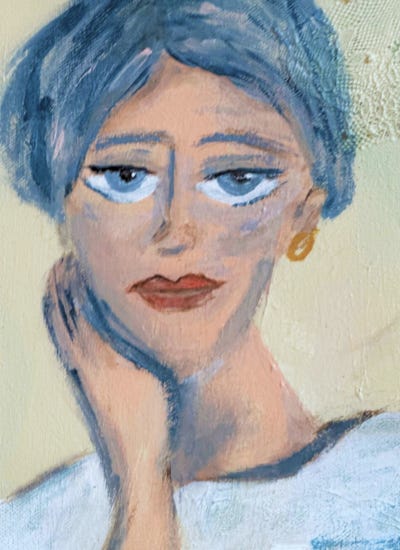
Harriet noted that “I’m fine” had smoothed things over. That it had protected everyone: my mother from worry, my family from discomfort, and me from having to explain something I didn’t want to say out loud. Harriet understood that sometimes fine meant: please don’t make this harder than it already is.
I’m fine. It’s fine. Everything is fine.
We’ve all said it. And we’ve all felt the subtle thud when someone else says it back.
Fine is a small word that carries a suspicious amount of emotional weight. It’s one of the most versatile words in the English language. It can mean something of excellent quality. Something delicate. Something attractive. Something acceptable. Adequate. Not great, not terrible - just… fine.
But when someone asks, “Is that okay?” and the answer is “It’s fine,” the word usually isn’t doing what it claims to be doing. It isn’t reassurance. It’s camouflage.
Fine can end an argument, but it can’t repair the distance the argument created. It closes the conversation without resolving it. This is where fine becomes a little more dangerous. It becomes a mutual agreement, the beginning of a quietly blossoming co-dependent relationship. Where one partner won’t ask the hard questions and the other doesn’t want to have to answer those questions - there’s no conflict - everything is fine.
But where fine lives, intimacy struggles to survive. Harriet’s “I’m fine” is code for: I don’t feel safe enough to say what I’m thinking.
Harriet has been a big part of my life for a long time. When I became a mother, she showed up immediately - at the first flicker of discomfort, the first sign of suffering. She knew I needed everyone to be fine. It was how I showed love - I made it all fine.
Now, when I look back at how I handled my children’s feelings around their father’s and my divorce, I get a physical pain in my stomach. Instead of letting them cry about the worries and changes, I rushed in to manage everything. I softened. I reframed. I pointed out the upsides of two houses. How fun it would be to paint their new bedrooms. I knew my actions had created their pain - and I didn’t think I could survive hearing that from them. I needed them to be fine with this new life.
In doing so I missed getting to know my children more deeply. I missed moments that mattered, moments where they could have felt their grief fully and learned something essential I never did: that they could hurt and still be okay. That both things can exist at the same time.
Harriet still tries to step in. I feel her when I raise a difficult subject and stop just short of the next question - the one that might go too deep and blow things up.
She is very good at pulling me off the ledge. But when I stop her - and I don’t smooth, fix, or redirect – I’ll hear those things I was afraid I would hear. And yes, it can hurt, but I don’t come undone. I too can hurt and be okay. It’s the speaking hard truths that I get tripped up on - but that is another story for another day.
The work now is to be fine with not fine. To pause long enough to ask:
If I weren’t trying to keep the peace, what would I actually say?
Sometimes the answer is still, “I’m fine.” But now I mean it.
And sometimes, it’s the beginning of something far more intimate - and far more honest - than fine ever allowed.
1 comment
This triggers so many emotions. I can’t even talk about it yet…and you know me, usually talking comes, like it or not. Thank you.